FD vs. Savings Account: How an FD Calculator Can Help You Decide?
FD vs. Savings Account: Learn how an FD calculator can help you make the right choice by comparing interest rates, returns, and benefits.
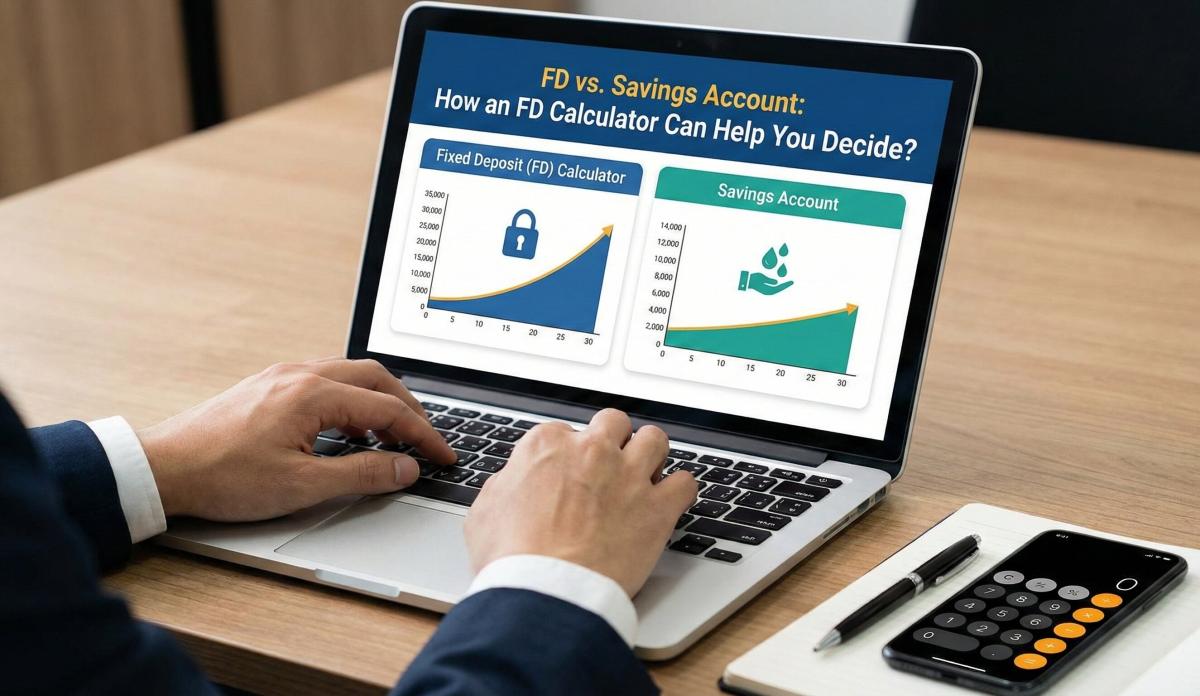
Table of Contents
According to a recent survey by SEBI, 95% of Indians prefer to invest in an FD or savings account. This enormous percentile showcases that people are more keen on safer investing options in India. With FD vs savings account being a constant debate, it could get confusing at times to choose one for your major portion of savings.
When deciding between a Fixed Deposit (FD) and a savings account, many factors come into play, such as interest rates, liquidity, and long-term benefits. Both options are popular in India for secure savings, but they serve different purposes. Let’s break down how these two differ and how an FD calculator can be a handy tool to make the best financial choice.
Understanding Fixed Deposits
A fixed deposit (FD) is a product offered by companies in the banking and related financial sectors. It provides a higher interest rate than a normal savings account, around 5-8%. In an FD, you lock in a certain sum of money for a certain period, which may vary from several months to several years. The rate of interest in the case of an FD is known in advance and does not alter with any change in time, making it less risky in terms of return rates.
Benefits of Fixed Deposits:
- Higher Interest Rates: FDs tend to have higher interest rates than savings accounts and are, therefore, preferred by conservative investors.
- Guaranteed Returns: Because the interest rate is fixed, the returns the holder will receive at maturity are easy to determine.
- Safety: A fixed deposit is one of the safest investment options, as the money is invested in a very safe and secure manner, normally in a reputable bank. The Deposit Insurance and Credit Guarantee Corporation (DICGC) protects FDs up to a certain amount in India.
Understanding Savings Accounts
A savings account is a financial institution account through which one can deposit and withdraw money. It is meant to encourage people to set aside their income to save by earning interest on the deposited cash. Nevertheless, the interest rates on savings accounts are usually lower than those of fixed deposit accounts, around 2.5-4%.
Benefits of Savings Accounts:
- Liquidity: Saving accounts provide convenience to customers, as they can deposit and withdraw their money at any time without incurring charges.
- No Lock-in Period: While opening FDs, there is always an investment horizon, while with savings accounts, anyone can get their money back at any time, which makes savings accounts better suited for those who might need their money at any given time.
- Flexibility: With a savings account, one can easily transfer money or make any payment without stepping out.
Key Differences: FD vs. Savings Account
Here are some of the crucial differences when we compare FD vs savings account:
|
Feature |
Fixed Deposit |
Savings Account |
|
Interest Rate |
Higher and fixed, usually around 5 to 8% |
Lower and variable, usually around 2.5 to 4% |
|
Liquidity |
Low (penalties for early withdrawal) |
High (easy access to funds) |
|
Tenure |
Fixed (months to years) |
No fixed tenure |
|
Risk |
Low |
Low |
|
Ideal For |
Long-term savings and guaranteed returns |
Short-term savings and liquidity |
How an FD Calculator Can Help?
An FD calculator is one of the instruments that can be used to measure the possible gains from a fixed deposit. By just typing in the amount invested, the rate of interest, and the maturity period, you can know the amount of interest that can be earned and the total maturity amount.
Here’s how an FD calculator can assist you in making an informed investment decision:
- Comparison of Returns: You can input various principal amounts, interest rates, and tenures and compare potential returns from one or more FDs. These entries may assist you in finding out which bank offers the desired rates best.
- Decision-Making for Tenure: If you decide on a longer period to fix, then you can observe how the maturity amount varies with the different types of tenures. The maturity amount can assist you in determining how long you have to put your money into an investment, depending on your goals.
- Interest Rate Impact: If you want to invest in an FD, a calculator where you can predict changes in interest rates and the corresponding potential returns. Knowledge gained from its use can guide you on when to invest or when to hold an investment.
- Risk Assessment: Although FDs and savings accounts are less risky compared to other investment avenues, it is possible to assess the risk factor in terms of investing your money for a fixed length of time through the use of the FD calculator. Here, you can balance your position by knowing how much returns on fixed deposits you want about the liquidity given by your savings account.
Conclusion: Making the Right Investment Decision
Knowing your financial requirements and objectives is crucial to making a proper investment decision. An FD calculator is a useful instrument that can help you compare and achieve your financial goals.
While considering the advantages of fixed deposit and savings accounts, remember to consider your priorities and choose the right thing to do. Whether you choose the increased returns of an FD or the flexibility of a savings account, sound decision-making will always bring you closer to achieving your financial goals.
FAQs:
1. What is the main fixed deposit comparison between savings accounts?
The main fixed deposit comparison lies in the interest rates and liquidity. Fixed deposits offer higher interest rates with a fixed tenure, while savings accounts provide lower interest rates with easy access to funds.
2. How can an FD calculator assist in my investment decision?
An FD calculator helps you estimate the returns on your fixed deposit based on the principal amount, interest rate, and tenure. It allows you to compare potential earnings and make informed choices.
3. Are fixed deposits safer than savings accounts?
Both options are considered low-risk investments. However, fixed deposits typically provide guaranteed returns and are insured up to a certain limit by the DICGC in India, offering an extra layer of safety.
4. Can I withdraw my money from a fixed deposit before the maturity date?
Yes, you can withdraw your money from a fixed deposit before maturity, but it may incur penalties, and you might receive a lower interest rate than initially promised.
Related Blogs

Published on Mar 27, 2026
Senior Citizen FD Rates 2026: Which Banks Offer the Highest Interest?
Compare senior citizen FD rates in 2026 and find which banks offer the highest interest. Learn about returns, tenures, and tips to choose the best FD.
Arjun Sharma
Content Lead – Banking & Payments

Published on Mar 27, 2026
Sukanya Samriddhi Yojana (SSY): Interest Rate, Rules & Calculator Guide 2026
Learn about Sukanya Samriddhi Yojana (SSY) including eligibility criteria, required documentation, step by step application process, tax benefits explanation and comparison b/w SSY, PPF and FD
Arjun Sharma
Content Lead – Banking & Payments
Published on Mar 02, 2026
Planning an FD? Don’t Miss These Top Questions About FD Calculators
Curious how FD calculators work? This guide answers the top questions to help you calculate returns, compare plans, and invest smarter in fixed deposits.
Priya Nair
Senior Compliance Editor at IFSC.co

Published on Mar 02, 2026
PPF (Public Provident Fund) Calculator – Returns, Interest & Planning Guide
A PPF Calculator helps you estimate the maturity value and interest earned on your Public Provident Fund investment. By entering your contribution amount, tenure, and current interest rate, you can project long-term returns and plan your savings effectively.
Priya Nair
Senior Compliance Editor at IFSC.co
Published on Mar 02, 2026
Recurring Deposit (RD) Calculator – Returns, Interest & Maturity Guide
An RD Calculator helps you estimate the maturity amount and interest earned on your Recurring Deposit investment. By entering your monthly deposit, tenure, and interest rate, you can project returns and plan your savings effectively.
Priya Nair
Senior Compliance Editor at IFSC.co
calculate Financial Calculators
EMI Calculator
FD Calculator
GST Calculator
Lumpsum Calculator
Mutual Fund Returns Calculator
PPF Calculator
RD Calculator
SIP Calculator
SWP Calculator
article Latest Blog Posts
ELSS vs PPF vs NPS: Which Tax-Saving Investment Gives the Best Returns?
Compare ELSS vs PPF vs NPS to find the best tax-saving investment. Understand returns, lock-in periods, and features to choose what suits your goals.
SIP & Investing • 11 MINS READ
How to Start SIP with ₹500 Per Month: Beginner's Guide to Mutual Funds
Learn how to start a SIP with ₹500 per month in mutual funds. Simple beginner’s guide to investing, building wealth, and growing money with small steps.
SIP & Investing • 13 MINS READ
Senior Citizen FD Rates 2026: Which Banks Offer the Highest Interest?
Compare senior citizen FD rates in 2026 and find which banks offer the highest interest. Learn about returns, tenures, and tips to choose the best FD.
FD, PPF & Savings • 12 MINS READ
Sukanya Samriddhi Yojana (SSY): Interest Rate, Rules & Calculator Guide 2026
Learn about Sukanya Samriddhi Yojana (SSY) including eligibility criteria, required documentation, step by step application process, tax benefits explanation and comparison b/w SSY, PPF and FD
FD, PPF & Savings • 11 MINS READ
2 reasons why online banking is important in today’s COVID-19 situation
Discover why online banking became essential during COVID-19. Learn how digital banking ensured safety, convenience, and uninterrupted financial services.
Digital Banking • 4 MINS READ