How to Calculate SIP Interest: A Step-by-Step Guide
Learn how to calculate SIP interest using formulas and calculators. Understand components like tenure, compounding, and returns to grow your investments wisely.

Table of Contents
SIP stands for Systematic Investment Plan, under which people invest a fixed amount of money periodically in mutual funds. It is a prudent method of investing that helps accumulate wealth in the long run. Investors need to know how to calculate SIP interest so that they can manage their money and investments effectively. In this blog, we will explain how to calculate SIP interest in detail and provide calculations for better understanding.
What is an SIP?
As we know, an SIP enables an investor to invest a fixed amount on a fixed date every month in a mutual fund scheme. This method takes advantage of rupee cost averaging and compounding interest and is, therefore, suitable for long-term investment.
Components of SIP Calculation
Before we dive into how to calculate SIP interest, here are the key components that one needs to know before calculating an SIP:
- Monthly Investment Amount (P): The constant amount that is put into the investment every month.
- Investment Period (n): The total number of months in which the investment is made.
- Rate of Return (r): The annual rate of return on the mutual fund.
- Compounding Frequency: Normally, returns are compounded annually while calculating the SIPs.
What is the Method of SIP Returns Calculation in the Excel Sheet?
Follow the below steps to calculate SIP returns in Excel:
- Enter SIP Dates: Under the first column, write the dates of SIP investments.
- Enter SIP Amounts: In the same table, in column B, put the amounts of the SIP money that you have made.
- Enter NAVs: In column C, put the Net Asset Values (NAV) on every SIP date of investment.
- Calculate Units: In column D, based on Cell B2 divide the SIP amount with NAV which is placed in Cell C2.
- Calculate Total Value: Total units must be multiplied by the latest NAV.
- Calculate Returns: The percentage return on an investment is calculated as ((Total Value –Total Investment) / Total Investment) x 100.
Functioning of SIP calculator for interest
The functioning of the SIP calculator is rooted in certain mathematical formulas. It focuses on the compound interest charged on SIP investments.
STEP 1- Understand the SIP Formula
FV = P [(1+i)^n-1] * (1+i)/i
where:
FV = Future Value
P = Rupee value that has been paid on each date
i = Annual return
n = Number of Installments
STEP 2: Before calculating, ensure you have the following information:
- Monthly SIP contribution (P)
- Expected annual rate of return (r)
- Investment tenure in years (t)
Almost every mutual fund house offers an online SIP calculator that gives an approximate amount of returns based on the fund's past performance. However, it is worth noting that past performances do not determine future profitability.
STEP 3: Determine the Compounding Frequency
The compounding frequency (n) is defined as the number of times the interest is applied to the principal amount and added within a year. As for most mutual funds, the compounding frequency is monthly; therefore, the value of n is equal to 12.
STEP 4: Plug in the Values and Calculate
For instance, let’s take an example of an SIP of ₹5000 per month for 10 years with an expected rate of return of 12% compounded monthly.
Given:
SIP contribution (P) = ₹5,000 per month
Expected rate of return (i) = 12% per annum or 0. 12
Investment tenure (n) = 10 years × 12 months = 120 installments
The formula:
FV = P × [(1 + i)^n - 1] × (1 + i) / i
Substituting the values:
FV = 5,000 × [(1 + 0. 12/12)^120 - 1] × (1 + 0. 12/12) / (0. 12/12)
FV = 5,000 × [(1. 01)^120 - 1] × 1. 01 / 0. 01
FV = 5,000 × [3. 1952 - 1] × 101
FV = 5,000 × 2. 1952 × 101
FV = ₹11,10,860
Hence, the amount that would be accumulated if ₹5,000 was invested every month for 10 years with an expected rate of return of 12% compounded monthly would be approximately ₹11,10,860.
STEP 5: Calculate the Interest Earned
Total Interest Earned = FV – Total Contributions
Total Contributions = SIP Contribution (P) × Number of Installments (n)
Total Contributions = 5000 × 120 = 600000
Total Interest Earned = ₹ 11,10,860 – ₹ 6,00,000 = ₹ 5,10,860
Hence, the total interest earned on this SIP investment would be around ₹5,10,860.
For the given example, the two formulae give similar output which states the future value of the SIP investment as well as the total interest earned.
STEP 6: Monitor and Adjust
It is important to note that the calculation is done at an expected rate of return per annum, which may change from time to time depending on the market forces. Therefore, the SIP investment should be periodically checked, and it is better to align your expectations with reality.
Furthermore, using this formula, you can also determine the interest rate earned on the SIP at different intervals, say annually or half-yearly, by changing the value of ‘n’.
Using Online SIP Calculators
Although manual calculation aids comprehension of the process, online SIP calculators can be useful to save time and minimize mistakes. These calculators involve entering the amount invested every month, the years to invest, and the expected rate of return per year. They then calculate the total future value and share information on the growth of the investment.
Factors Affecting SIP Returns
It’s important to keep in mind that there are many factors that can affect your returns. Here are some key factors:
- Market Volatility: There is always a possibility of changes in the market conditions which may have an impact on the performance of the mutual fund.
- Investment Duration: Compounding has more impact when investment periods are longer.
- Rate of Return: The actual rate of return may differ depending on the performance of the particular fund involved.
- Investment Consistency: Consistent and systematic investing is the key to compounding.
Bottom Line
SIP interest can easily be computed using these steps or online calculators to determine the possible profits one could make from the investment. Factors such as investment quantity, expected rate of return, and investment period should also be taken into consideration.
It is essential to know about compounding, how to calculate SIP interest, and how it increases your benefits at a steady rate. With this knowledge, you can set appropriate expectations for your SIP investments and be in a better position to achieve your financial goals.
Related Blogs
Published on Mar 26, 2026
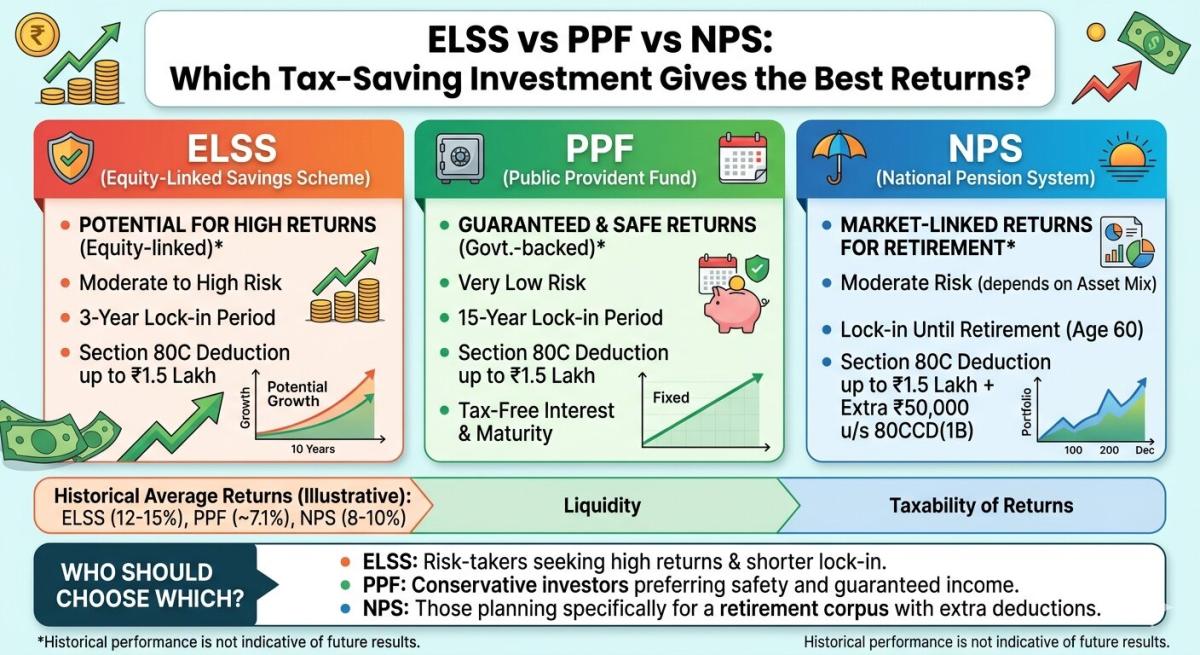
ELSS vs PPF vs NPS: Which Tax-Saving Investment Gives the Best Returns?
Compare ELSS vs PPF vs NPS to find the best tax-saving investment. Understand returns, lock-in periods, and features to choose what suits your goals.
Arjun Sharma
Content Lead – Banking & Payments

Published on Mar 26, 2026
How to Start SIP with ₹500 Per Month: Beginner's Guide to Mutual Funds
Learn how to start a SIP with ₹500 per month in mutual funds. Simple beginner’s guide to investing, building wealth, and growing money with small steps.
Arjun Sharma
Content Lead – Banking & Payments

Published on Mar 02, 2026
What is a Lumpsum Calculator and How Does It Work? Benefits, Accuracy & Planning Tips
Learn how a Lumpsum Calculator works, how it estimates one-time investment returns, and how to use it for smarter financial planning.
Priya Nair
Senior Compliance Editor at IFSC.co
Published on Mar 02, 2026
Mutual Fund Returns Calculator: How It Works, Accuracy & FAQs Explained
A Mutual Fund Returns Calculator helps you estimate the future value of your mutual fund investment using inputs like investment amount, tenure, contributions, and expected returns. It uses compounding to project potential growth and helps you plan smarter investment decisions.
Priya Nair
Senior Compliance Editor at IFSC.co

Published on Apr 10, 2025
Financial Planning: Using SIP Calculators Effectively
Confused about future finances? Learning how to use SIP Calculators can help you reach your goals! Invest small, grow big.
Priya Nair
Senior Compliance Editor at IFSC.co
calculate Financial Calculators
EMI Calculator
FD Calculator
GST Calculator
Lumpsum Calculator
Mutual Fund Returns Calculator
PPF Calculator
RD Calculator
SIP Calculator
SWP Calculator
article Latest Blog Posts
ELSS vs PPF vs NPS: Which Tax-Saving Investment Gives the Best Returns?
Compare ELSS vs PPF vs NPS to find the best tax-saving investment. Understand returns, lock-in periods, and features to choose what suits your goals.
SIP & Investing • 11 MINS READ
How to Start SIP with ₹500 Per Month: Beginner's Guide to Mutual Funds
Learn how to start a SIP with ₹500 per month in mutual funds. Simple beginner’s guide to investing, building wealth, and growing money with small steps.
SIP & Investing • 13 MINS READ
Senior Citizen FD Rates 2026: Which Banks Offer the Highest Interest?
Compare senior citizen FD rates in 2026 and find which banks offer the highest interest. Learn about returns, tenures, and tips to choose the best FD.
FD, PPF & Savings • 12 MINS READ
Sukanya Samriddhi Yojana (SSY): Interest Rate, Rules & Calculator Guide 2026
Learn about Sukanya Samriddhi Yojana (SSY) including eligibility criteria, required documentation, step by step application process, tax benefits explanation and comparison b/w SSY, PPF and FD
FD, PPF & Savings • 11 MINS READ
2 reasons why online banking is important in today’s COVID-19 situation
Discover why online banking became essential during COVID-19. Learn how digital banking ensured safety, convenience, and uninterrupted financial services.
Digital Banking • 4 MINS READ