Digital Rupee (e₹) vs. UPI: Understanding the Future of Indian Currency
Understand the difference between Digital Rupee (e₹) and UPI in 2026. Learn when to use each, privacy benefits, and how to adopt e₹ today.
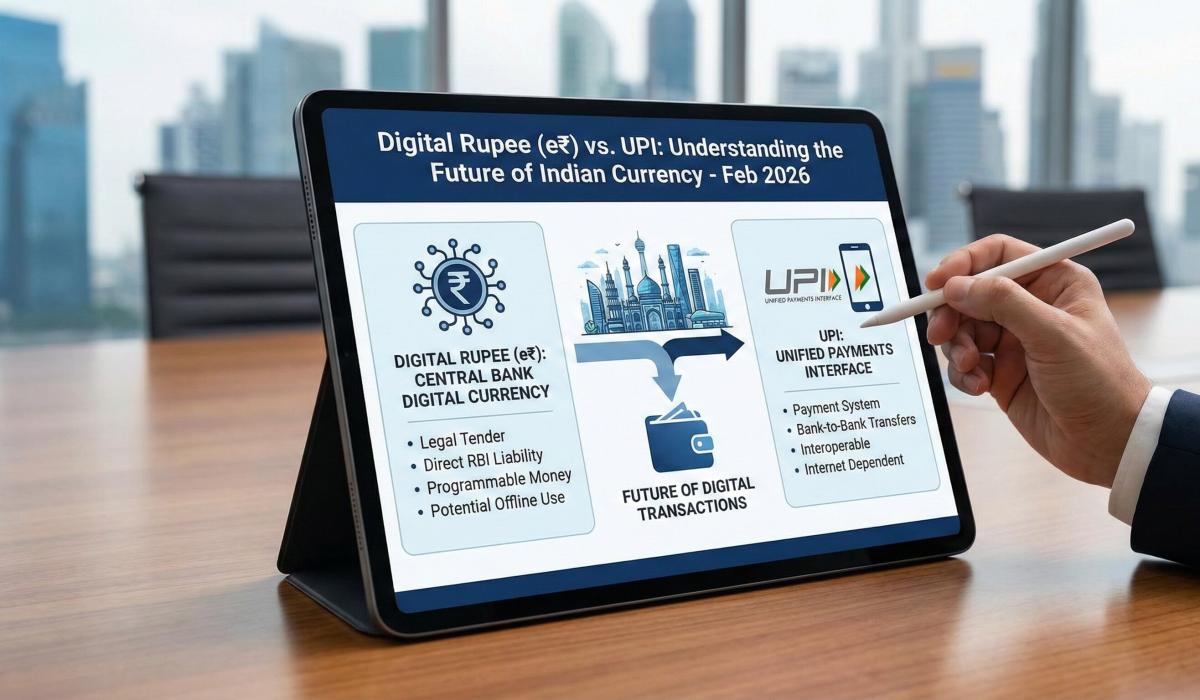
Table of Contents
It is 2026, and the QR code is now as quintessentially Indian as the auto-rickshaw. You scan to pay for your morning chai, your metro ticket, and even your vegetable vendor. But recently, you might have noticed a subtle shift. Your banking app now asks you: "Pay via UPI or e₹ (Digital Rupee)?"
For most of us, the experience feels identical. Money leaves our phone, the green tick appears, and the vendor gets paid. But under the hood, these two systems are as different as a Cheque and a Cash Note.
With the Reserve Bank of India (RBI) aggressively rolling out Offline Functionality for the Digital Rupee in late 2025, and major banks integrating e₹ wallets directly into their primary apps, the confusion has peaked. Why do we need "Digital Money" when we already have "Digital Payments"?
As a consumer in 2026, understanding this distinction isn't just academic—it is about privacy, reliability, and knowing which tool to use when the server goes down. Here is your definitive guide to the battle of the titans: e₹ vs. UPI.
The 2026 Cheat Sheet: e₹ vs. UPI
Let’s strip away the technical jargon. Here is how these two stack up in the current banking ecosystem.
|
Feature |
Unified Payments Interface (UPI) |
Digital Rupee (e₹ - Retail) |
|
What is it? |
A Payment Rail. It moves money from Bank A to Bank B. |
Digital Currency. It is money (a digital banknote). |
|
Who Holds It? |
Your Bank (SBI, HDFC, etc.). It is a liability of the bank. |
The RBI. It is a sovereign liability (like cash). |
|
Internet Requirement |
Mandatory (Lite version exists but limited). |
Optional. 2026 updates allow offline "Tap" transfers. |
|
Settlement |
Instant, but depends on Bank Servers being up. |
Instant & Final. Does not touch the core banking system. |
|
Anonymity |
None. Every transaction is recorded on your bank statement. |
High for small amounts. Transactions <₹500 don't clutter bank statements. |
|
Interest? |
Yes. Money sits in Savings A/c earning 3-4%. |
No. Just like cash in your physical wallet, e₹ earns 0%. |
Deep Dive: The Mechanics of Your Money
To choose the right tool, you need to understand the "Plumbing" behind the screen.
1. UPI: The "Digital Cheque"
Think of UPI as a super-fast courier service. When you send ₹500 via Google Pay, you are instructing your bank to move ₹500 to the merchant's bank.
- The 2026 Context: UPI has evolved. With "Credit Line on UPI" now standard, you can use UPI to spend borrowed money (like a credit card). It is robust, but it has a weakness: Intermediaries.
- The Flaw: If your bank's server is down, or the NPCI switch is overloaded, the courier fails. The money is stuck.
2. Digital Rupee (e₹): The "Digital Cash"
Think of e₹ as the cash in your pocket, but in code form. When you pay ₹500 in e₹, you aren't asking a bank to move money. You are simply handing over a digital token from your wallet to theirs.
- The 2026 Game Changer: Programmability.
- Example: In 2026, many corporate "Meal Vouchers" or government "School Uniform Subsidies" are issued as Programmable e₹. This money can only be spent at specific merchants (restaurants or uniform shops). UPI cannot do this natively with the same precision.
- The Privacy Angle: When you pay via UPI, your bank statement records: "₹50 paid to Ramesh Kirana Store." Do this 10 times a day, and your statement becomes 50 pages long. With e₹, your bank statement simply shows "₹5,000 withdrawn to e-Wallet." The actual coffee/chai spends remain private in your wallet ledger, not your bank statement.
Senior Editor’s Verdict: The "Hybrid Wallet" Strategy
In 2026, you shouldn't choose one. You should use both, but for different purposes.
"My Advice: Use UPI for 'High Value,' Use e₹ for 'High Volume'."
When to use UPI:
- Large Purchases: Buying a TV, paying rent, or flight tickets. You want the bank record for these.
- Credit Payments: When you want to use your "RuPay Credit Card on UPI" to earn reward points.
- Earning Interest: Keep the bulk of your money in your Savings Account to earn that 3-7% interest.
When to use Digital Rupee (e₹):
- The "Chillar" Transactions: Buying vegetables, auto rides, or cigarettes. Use e₹ to keep your primary bank statement clean.
- Bad Network Areas: Traveling to a remote hill station? The e₹ "Offline Tap" feature (using NFC) works even without a signal, whereas UPI might time out.
- Privacy: If you don't want your bank (or spouse) to see every single merchant name on your statement, e₹ offers cash-like privacy.
The Math: The Cost of "Cash"You might ask, "If e₹ earns 0% interest, why would I move money there from my Savings Account?"
Let's calculate the "Opportunity Cost" of holding Digital Rupee.
Suppose you keep ₹2,000 in your e-Wallet for daily petty expenses.
- Scenario A: Money in Savings Account (UPI)
- Interest Rate: 3.00% p.a.
- Interest earned on ₹2,000 in a month: ₹5
- Scenario B: Money in e-Wallet (e₹)
- Interest Rate: 0%
- Interest earned: ₹0
The "Cost" of Privacy: You are "losing" ₹5 per month to enjoy the benefits of offline payments, faster settlement, and a clean bank statement.
- Verdict: For small amounts (wallet balance <₹5,000), the interest loss is negligible compared to the convenience of having "Digital Cash" that works when bank servers are down.
Security & Risks: Is e₹ Safe?
In 2026, the security conversation has shifted from "Hacking" to "Traceability."
- The "Anonymity" Myth:
While e₹ is private from your bank, it is not invisible to the RBI. Unlike physical cash which is truly untraceable, every e₹ token leaves a digital footprint. However, the RBI has stated it has no interest in tracking retail transactions below a certain threshold (currently ₹50,000).
- Wallet Theft:
If you lose your phone:
-
- UPI: Your money is safe in the bank. You just need to block the SIM/Card.
- e₹: It behaves like cash. However, unlike physical cash, e₹ is recoverable. Since the tokens are linked to your identity (even if anonymously), the bank can "burn" the lost tokens and reissue them to you after identity verification. This is a massive upgrade over physical cash.
- The "Bank Run" Risk:
During a banking crisis (like the SVB collapse in the US), people rush to withdraw cash. In a digital world, they would rush to convert Bank Deposits $\rightarrow$ Digital Rupee. Why? Because e₹ is a Sovereign Guarantee. Even if your bank collapses, the e₹ in your wallet is safe because it is a liability of the RBI, not the bank.
Actionable Checklist: Adoting e₹ in 2026
- Download the Pilot App: Most major banks (ICICI, SBI, IDFC First) now have a dedicated "Digital Rupee" section inside their main app. You don't need a separate app anymore.
- Load, Don't Hoard: Treat it like your physical wallet. Load ₹2,000 for the week. Do not transfer your life savings here (you lose interest).
- Enable Biometrics: Ensure your e-Wallet is locked with Fingerprint/FaceID. Since it holds "Cash," it needs to be guarded.
- Test "Offline Mode": Next time you are in a basement or flight mode, try the "Token Transfer" feature with a friend to understand how the NFC-based offline payment works.
Frequently Asked Questions (FAQ)
1. Can I transfer e₹ to my friend who uses a different bank?
Yes. Just like UPI, e₹ is fully interoperable. You can send Digital Rupees from your SBI Wallet to your friend's HDFC Wallet instantly.
2. Does the merchant need a separate QR code for e₹?
No. In 2026, the QR Code Interoperability is complete. You can scan any standard UPI QR code using your e₹ app, and the merchant will receive the money (either as e₹ or converted to bank credit).
3. Will e₹ replace UPI?
No. They will coexist. UPI is for "Bank-to-Bank" transfers. e₹ is for "Wallet-to-Wallet" transfers. UPI is the truck; e₹ is the cargo.
4. Is e₹ taxable?
The usage is not taxable, but the source is. If you receive your salary in e₹, it is taxable income. It is treated exactly like physical INR currency for tax purposes.
5. What happens if I lose my phone with e₹ in it?
Unlike a physical wallet where the cash is gone forever, you can restore your e₹ wallet on a new phone using your SIM card and KYC authentication. The tokens are virtually retrieved from the cloud ledger.
Related Blogs
Published on Aug 05, 2025
Bank of Baroda (BoB) World: How to Use the Unified App for All Your Banking Needs
Explore unified banking apps combining NEFT, RTGS, UPI, and more. Simplify your finances with integrated digital banking in 2026.
Priya Nair
Senior Compliance Editor at IFSC.co

Published on Jun 22, 2025
The Future of Banking: How AI and Biometrics are Replacing Traditional Passwords
Explore how AI and biometrics are transforming banking security in 2026. Learn about passwordless authentication and secure digital banking.
Priya Nair
Senior Compliance Editor at IFSC.co
Published on Jun 19, 2025
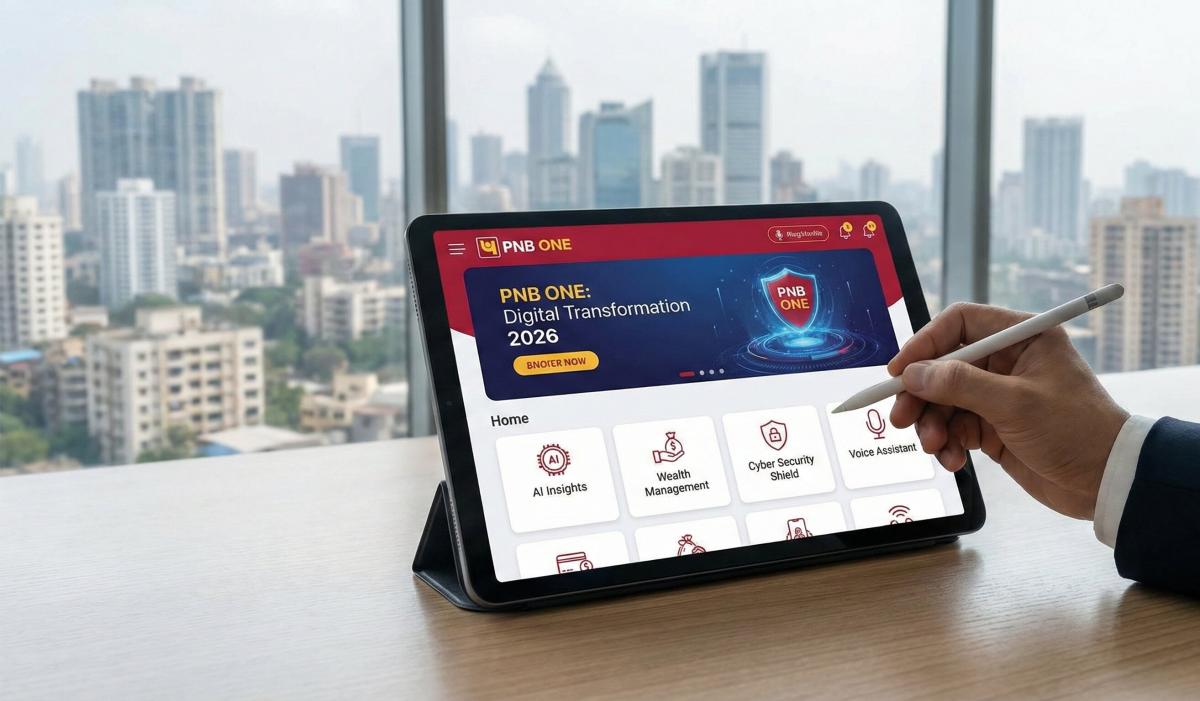
Punjab National Bank (PNB) Digital Transformation: Navigating the PNB ONE App in 2026
Master PNB ONE app in 2026. Learn setup, new security protocols, troubleshooting, and how to use IFSC codes for seamless digital banking.
Arjun Sharma
Content Lead – Banking & Payments
calculate Financial Calculators
EMI Calculator
FD Calculator
GST Calculator
Lumpsum Calculator
Mutual Fund Returns Calculator
PPF Calculator
RD Calculator
SIP Calculator
SWP Calculator
article Latest Blog Posts
A Comprehensive Guide to Home Loan Interest Rates: Fixed vs. Floating in 2026
A detailed 2026 guide to home loan interest rates comparing fixed, floating, and hybrid options. Learn the real cost difference, EMI impact, risks, RBI policies, and which option saves you more over 20 years.
EMI & Loans • 8 MINS READ
Mutual Fund Returns Calculator: How It Works, Accuracy & FAQs Explained
A Mutual Fund Returns Calculator helps you estimate the future value of your mutual fund investment using inputs like investment amount, tenure, contributions, and expected returns. It uses compounding to project potential growth and helps you plan smarter investment decisions.
SIP & Investing • 6 MINS READ
NEFT vs RTGS vs IMPS vs UPI: Which Transfer Method Should You Use?
NEFT, RTGS, IMPS, or UPI — which transfer method should you use? Compare limits, timing, charges and best use cases. Full guide with 2025 RBI & NPCI figures.
Banking & Transfers • 16 MINS READ
New Tax Regime vs Old Tax Regime: A Real-Numbers Comparison for Salaried Indians (FY 2025-26)
New vs old tax regime FY 2025-26 — compare real tax on ₹6L, ₹10L & ₹15L salaries. See who pays zero tax and find your break-even point.
Tax & Financial Planning • 15 MINS READ
Planning an FD? Don’t Miss These Top Questions About FD Calculators
Curious how FD calculators work? This guide answers the top questions to help you calculate returns, compare plans, and invest smarter in fixed deposits.
FD, PPF & Savings • 5 MINS READ