Understanding Central KYC (CKYCR): How It Simplifies Your Banking Experience
Learn about Central KYC Registry (CKYCR) in India. Understand its role, benefits, and how it streamlines banking KYC process.
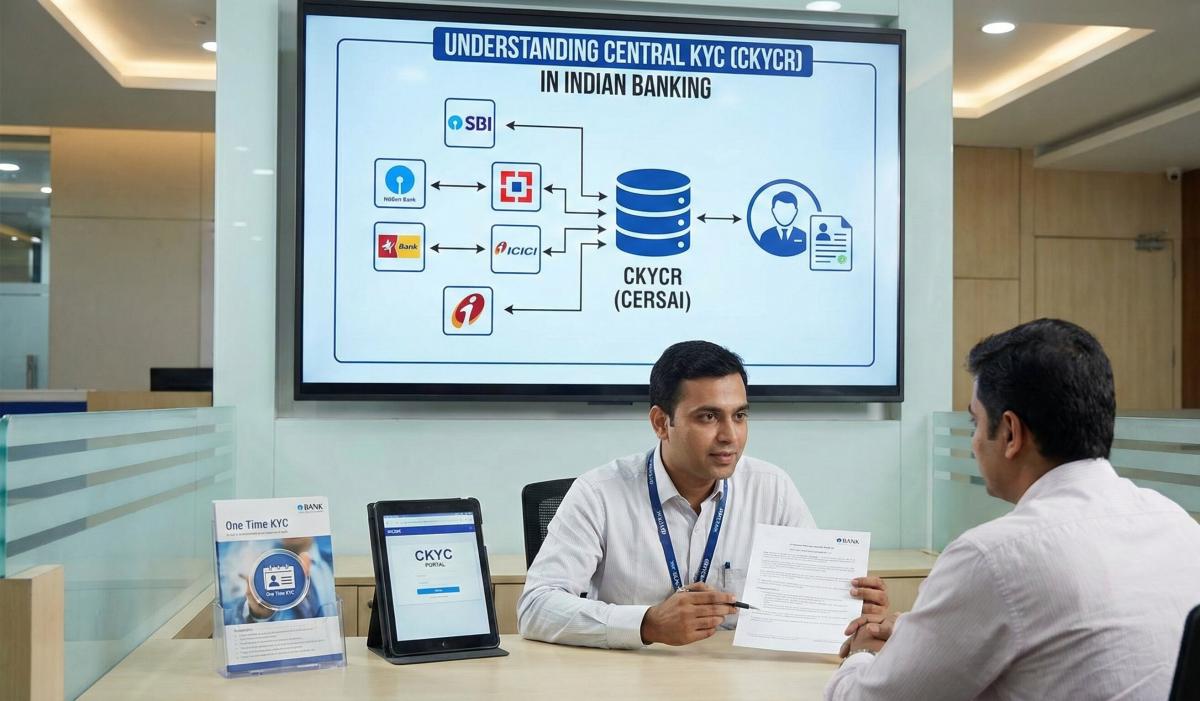
Table of Contents
- Before vs. After: The "One India, One KYC" Shift
- Deep Dive: The 4 Types of CKYC Accounts
- Senior Editor’s Verdict: Why You Need Your 14-Digit Number Now
- Who needs to act?
- The Math: The "Time Cost" of Ignoring CKYC
- Security & Risks: Is a Central Database Safe?
- Actionable Checklist: Verify Your CKYC Status Today
- Frequently Asked Questions (FAQ)
If you tried to open a new Demat account or buy an insurance policy this January, you might have noticed something refreshing: you didn't have to submit a single piece of paper. You simply quoted a 14-digit number, entered an OTP, and were approved in seconds.
Welcome to the mature era of Central KYC (CKYCR).
While CKYC has existed for years, 2026 is the year it truly became the "Aadhaar of Financial Investing." With the RBI’s Master Direction on KYC (Updated Jan 2026) and the new CERSAI mandate effective March 1, 2026, your "Financial Digital ID" is now as critical as your PAN card.
However, confusion remains. Many users still mix up "e-KYC" with "Central KYC," leading to frozen accounts or rejected loan applications. As the "Low-Risk Customer" updation window extends to June 2026, understanding this system is no longer optional—it is essential for anyone managing money in India.
Here is your comprehensive, expert guide to navigating the Central KYC landscape in 2026.
Before vs. After: The "One India, One KYC" Shift
To understand why CKYC matters, we must look at the "Siloed Era" versus the current "Unified Era."
|
Feature |
Old System (Siloed KYC) |
New System (Central KYC 2026) |
|
Documentation |
Submitted separately to Bank A, Mutual Fund B, and Insurer C. |
One-Time Submission. Data stored centrally; accessible by all regulated entities. |
|
Verification |
Physical documents or localized e-KYC (Aadhaar). |
CKYC Identifier: A unique 14-digit number fetches your pre-verified data. |
|
Updates |
Moving house? You had to visit 10 different branches to update your address. |
Universal Update: Update once with your bank; the change reflects across your Demat and Insurance. |
|
Interoperability |
None. A verified bank customer was a "stranger" to a stockbroker. |
100% Interoperable. Your banking KYC status is valid for stock markets (SEBI) and insurance (IRDAI). |
Deep Dive: The 4 Types of CKYC Accounts
Not all CKYC accounts are created equal. In 2026, many users are shocked when their mutual fund investment is capped at ₹50,000 because they hold the "wrong" type of CKYC.
The Central Registry of Securitisation Asset Reconstruction and Security Interest of India (CERSAI) classifies accounts into four distinct buckets:
1. Normal Account (The Gold Standard)
- What is it? You submitted six officially valid documents (PAN, Aadhaar/Passport, etc.) and underwent "Face-to-Face" or "Video-CIP" verification.
- Benefits: No investment limits. You can invest Crores in stocks or open unlimited bank accounts.
- 2026 Status: This is what you should aim for.
2. Simplified / Low-Risk Account
- What is it? You submitted "Simplified Measures" documents (like a NREGA card) because standard proofs weren't available.
- The Catch: Your account prefix code in the CKYC registry will flag you as "Simplified," often triggering higher scrutiny for large transactions.
3. Small Account
- What is it? Opened without official documents, usually for financial inclusion.
- The Limit: Valid only for 12 months. Total credits cannot exceed ₹1 Lakh per year.
- Risk: If you don't upgrade this to "Normal" by submitting docs, the account freezes automatically.
4. OTP-Based e-KYC Account (The Most Common Trap)
- What is it? You opened an account instantly using just an Aadhaar OTP, without a video call or physical signature.
- The 2026 Restriction: As per RBI guidelines, you are restricted to a maximum balance of ₹1 Lakh and term loans up to ₹60,000. To remove this cap, you must complete a Video KYC (V-CIP) to convert this into a "Normal" CKYC account.
Senior Editor’s Verdict: Why You Need Your 14-Digit Number Now
In 2026, the RBI and CERSAI have tightened the screws on "Anonymous" banking.
"My Advice: Do not wait for your bank to ask for it. proactively find your CKYC Number."
Why? Because of the March 1, 2026 Mandate.
Starting this March, if you apply for any secured loan (Home Loan, Car Loan) or your assets are being registered under CERSAI (security interest), the CKYC Identifier of the Debtor is mandatory. If you don't have this number generated and "Active," your loan disbursement could be delayed by weeks while the bank scrambles to generate a fresh registry entry for you.
Who needs to act?
- Freelancers/Sole Proprietors: Your personal CKYC is often linked to your business accounts. Ensure it is "Normal" and not "OTP-based."
- NRIs: If your residential status changed to "Non-Resident," you must update your CKYC. The 2026 tax systems cross-verify CKYC data with your Income Tax Return (ITR). A mismatch can trigger a notice.
The Math: The "Time Cost" of Ignoring CKYC
Why care about a number? Let’s calculate the "Time Tax" you pay without it.
Suppose you move to a new city in 2026 and need to update your address across your financial life.
Scenario A: Without Active CKYC (The Old Way)
- Bank Visit: 1 Hour (Travel + Queue)
- Credit Card Issuer: 45 Mins (Call + Emailing docs)
- Demat Broker: 30 Mins (App upload + wait time)
- Life Insurer: 1 Hour (Physical form submission often required)
- Total Time Wasted: ~4.5 Hours + Stress of tracking 4 different applications.
Scenario B: With Central KYC (The 2026 Way)
- Bank Visit: 15 Mins (Submit address proof once).
- Automatic Trigger: The bank pushes the update to CERSAI.
- The Ripple Effect: Within 7-10 days, your Insurer and Broker fetch the new data from CKYC.
- Total Time Spent: 15 Minutes.
That is a 94% reduction in administrative hassle.
Security & Risks: Is a Central Database Safe?
Centralizing data raises privacy concerns. CERSAI, the body managing this, operates under the PMLA (Prevention of Money Laundering Act).
- Who can see my data?
Only "Reporting Entities" (Banks, SEBI brokers) registered with CERSAI can fetch your data, and only when you provide consent (usually via OTP or application authorization). Random people cannot "Search" your financial history.
- The "Data Hygiene" Protocol:
In late 2025, CERSAI introduced strict "Data Hygiene" protocols. If your photo in the registry is blurry or your name doesn't match your PAN exactly, your CKYC status changes to "On Hold."
-
- Risk: An "On Hold" status means you cannot open any new account with any financial institution until you fix the error at your home bank.
Actionable Checklist: Verify Your CKYC Status Today
Don't wait for a transaction failure. Perform this "Health Check" immediately:
- Check Your Status: Visit www.ckycindia.in/ckyc/index.php or your bank’s net banking portal. Look for the "KYC Status" tab.
- Get the Number: If you don't know your 14-digit identifier, check your Consolidated Account Statement (CAS) from your Mutual Fund house (CAMS/KFintech). It is usually printed at the top.
- Audit the Details: Does the registry have your current mobile number? If the OTP goes to an old dead number, you are locked out of the financial system. Update it at your bank branch immediately.
- Convert OTP Accounts: If your status says "OTP Based," request a Video KYC call with your bank to upgrade to "Normal" status. This unlocks higher investment limits.
Frequently Asked Questions (FAQ)
1. Is CKYC mandatory for everyone?
Yes. Since 2017, it has been mandatory for all new financial relationships. In 2026, even legacy accounts are being back-filled into the registry. You cannot escape it.
2. I already have e-KYC. Do I need CKYC?
Yes. e-KYC (Aadhaar based) is a process to verify you. CKYC is the repository where that data is stored. e-KYC is the key; CKYC is the vault.
3. Can I update my details directly on the CKYC website?
No. Individuals cannot write to the registry directly. You must go to your financial institution (Bank/Broker), submit the update request, and they will push the change to CERSAI.
4. Why did my Mutual Fund SIP get rejected saying "KYC On Hold"?
This usually happens if CERSAI detects a discrepancy (e.g., Name on PAN does not match Name on Bank Account). You must submit a "KYC Change Request" form with a matching name proof to clear the hold.
5. How much does it cost to get a CKYC number?
Zero. It is a backend regulatory requirement. Banks and financial institutions bear the cost of uploading your documents to CERSAI. You should never pay an agent for "CKYC Registration."
Related Blogs
Published on Jul 18, 2025
Axis Bank Mobile Banking: Steps to Reset Your MPIN and Secure Your Transactions (2026 Guide)
Forgot your MPIN? Learn how to reset it safely. Step-by-step guide for all banks to recover your mobile banking access securely.
Priya Nair
Senior Compliance Editor at IFSC.co
Published on Jul 05, 2025
How to Update Your KYC in SBI Online Without Visiting the Branch (2026 Guide)
Update your SBI KYC online easily. Follow our step-by-step guide to complete KYC verification without visiting the branch in 2026.
Arjun Sharma
Content Lead – Banking & Payments
Published on Jul 02, 2025
ICICI Bank iMobile Pay: How to Securely Manage Your Account and Find Branch IFSCs (2026 Guide)
Learn best practices for secure account management and how to find your branch IFSC code. Protect your banking information effectively.
Arjun Sharma
Content Lead – Banking & Payments
Published on Jun 28, 2025
How to Detect and Avoid Digital Banking Scams: A 2026 Security Handbook
Protect your finances! Learn how to detect and avoid digital banking scams in 2026. Recognize phishing, fraud, and secure your accounts today.
Arjun Sharma
Content Lead – Banking & Payments
calculate Financial Calculators
EMI Calculator
FD Calculator
GST Calculator
Lumpsum Calculator
Mutual Fund Returns Calculator
PPF Calculator
RD Calculator
SIP Calculator
SWP Calculator
article Latest Blog Posts
A Comprehensive Guide to Home Loan Interest Rates: Fixed vs. Floating in 2026
A detailed 2026 guide to home loan interest rates comparing fixed, floating, and hybrid options. Learn the real cost difference, EMI impact, risks, RBI policies, and which option saves you more over 20 years.
EMI & Loans • 8 MINS READ
Mutual Fund Returns Calculator: How It Works, Accuracy & FAQs Explained
A Mutual Fund Returns Calculator helps you estimate the future value of your mutual fund investment using inputs like investment amount, tenure, contributions, and expected returns. It uses compounding to project potential growth and helps you plan smarter investment decisions.
SIP & Investing • 6 MINS READ
NEFT vs RTGS vs IMPS vs UPI: Which Transfer Method Should You Use?
NEFT, RTGS, IMPS, or UPI — which transfer method should you use? Compare limits, timing, charges and best use cases. Full guide with 2025 RBI & NPCI figures.
Banking & Transfers • 16 MINS READ
New Tax Regime vs Old Tax Regime: A Real-Numbers Comparison for Salaried Indians (FY 2025-26)
New vs old tax regime FY 2025-26 — compare real tax on ₹6L, ₹10L & ₹15L salaries. See who pays zero tax and find your break-even point.
Tax & Financial Planning • 15 MINS READ
Planning an FD? Don’t Miss These Top Questions About FD Calculators
Curious how FD calculators work? This guide answers the top questions to help you calculate returns, compare plans, and invest smarter in fixed deposits.
FD, PPF & Savings • 5 MINS READ